Why Your Inner Critic Might Be a Secret Supervillain
Why Your Inner Critic Might Be a Secret Supervillain
If you have written a book or two already, you have probably discovered something deeply unfair about the writing process.
Finishing your first draft is hard. Finishing your second draft is harder. But somehow, letting people actually read the thing can feel almost impossible.
You can spend months or years building a story, polishing scenes, rewriting dialogue, fixing plot holes, and tweaking chapter openings. Then, just when the book is finally close to being finished, a voice appears in the back of your mind.
It does not sound dramatic. It does not arrive in a black cloak with a lightning storm behind it. It sounds reasonable.
“This scene is weak.”
“No one is going to care about this character.”
“You should probably rewrite the whole thing again.”
“Other writers are better than you.”
“You are not ready yet.”
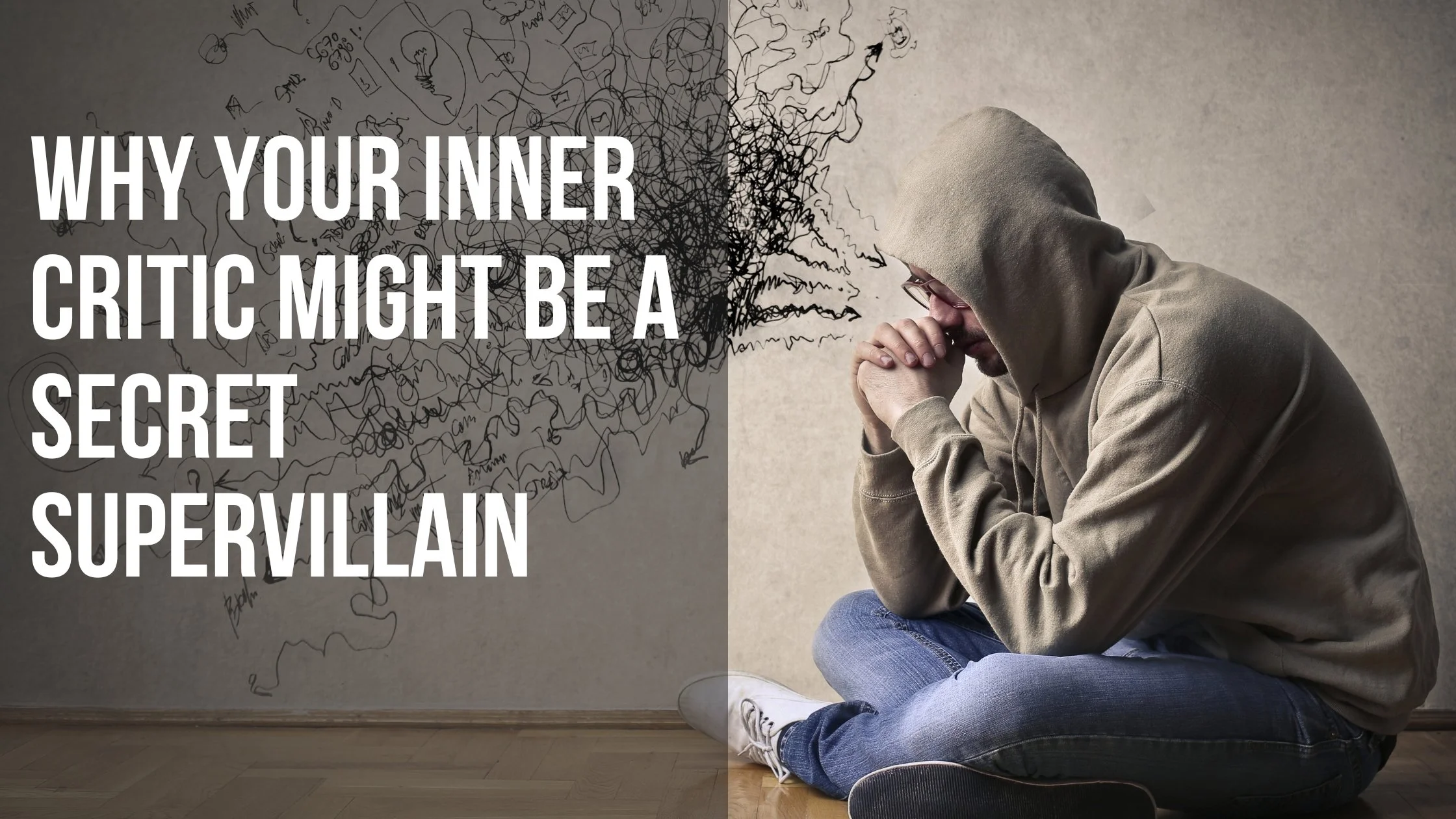
That voice is your inner critic. And if you are not careful, it can become the supervillain of your writing life.
The Problem With Being “Experienced”
New writers often struggle because they do not know what makes a good story. More experienced writers struggle because they know exactly what makes a good story.
That sounds like a strength, and in many ways it is. You can spot clunky dialogue faster. You notice pacing issues earlier. You recognise weak character arcs, repetitive descriptions, and scenes that do not pull their weight.
The trouble is that your taste often improves faster than your confidence. You become better at recognising flaws, but not always better at forgiving yourself for having them. When you have already written a novel or two, your standards get higher. You know what you are capable of. You know when a scene falls short of the version in your head. The danger is that your inner critic starts pretending it is helping.
It tells you that you are being “professional” by endlessly editing.
It tells you that you are “raising your standards” by refusing to release anything.
It tells you that if you wait just a little longer, rewrite just one more chapter, fix just one more subplot, then maybe the book will finally be good enough.
But there is a difference between improving a project and trapping it in permanent development. At some point, perfectionism stops being quality control and starts becoming fear.
Your Inner Critic Loves Moving Goalposts
One of the most frustrating things about self-doubt is that it rarely disappears after you improve. You would think that finishing a novel, getting better at writing, or even receiving positive feedback would quiet that critical voice. Usually, it does the opposite.
You finish a book and think, “I finally proved I can do this.”
Then your inner critic says, “Fine, but can you do it again?”
You write a second book.
“Okay, but this one is not as good as the last one.”
You get positive reviews.
“They are probably just being nice.”
You get an agent.
“You got lucky.”
You publish.
“What if everyone hates the next one?”
Your inner critic is very good at changing the rules.
That is why so many writers feel like frauds no matter how much they achieve.
Even successful authors are not immune to it.
Neil Gaiman has spoken openly about feeling like a fraud despite writing bestselling books and creating beloved stories for decades. He once described being convinced that someone would eventually discover he did not know what he was doing.
Maya Angelou reportedly felt this way too, despite writing multiple acclaimed books. She once said that after every book she worried people would realise she had “run a game on everybody.”
Stephen King famously threw the first draft of Carrie in the bin because he believed it was not good enough. If his wife had not pulled it back out and encouraged him to keep going, one of the most successful horror novels of all time might never have existed.
Virginia Woolf filled her diaries with doubts about her work.
The point is not that successful writers magically overcome self-doubt; they learn to work while doubting themselves.
The Inner Critic Has Terrible Timing
Your inner critic tends to show up most aggressively during the exact moments when you need confidence the most.
When you are halfway through a first draft and the excitement is wearing off.
When you are about to send your manuscript to beta readers.
When you are considering self-publishing.
When you are thinking about querying agents.
When you are deciding whether to share your work online.
That is because your inner critic is not really trying to improve your writing.
It is trying to protect you.
It wants to save you from embarrassment, rejection, criticism, failure, and disappointment.
The problem is that it usually protects you by stopping you from doing anything at all.
You do not risk failure if you never finish the book.
You do not risk rejection if you never send the query.
You do not risk bad reviews if you never publish.
From your inner critic’s point of view, hiding is the safest option.
Unfortunately, hiding is also the fastest way to leave stories unfinished.
You Cannot Edit a Book That Does Not Exist
A lot of writers get stuck because they are trying to edit and draft at the same time. They write one chapter, then spend three weeks rewriting it.
Then they lose momentum. Then they start over. Then they convince themselves the project is broken.
The problem is not necessarily the book. The problem is that the inner critic has climbed into the passenger seat far too early.
Drafting and editing require completely different mindsets. Drafting is messy, impulsive, emotional, and often chaotic. Editing is analytical, structured, and critical. Trying to do both at once is like trying to drive with one foot on the accelerator and one foot on the brake.
One useful trick is to deliberately separate the two modes.
When you are drafting, give yourself permission to write badly.
Write the awkward scene. Write the cliché line. Write the clunky placeholder description.
You can fix almost anything later. But you cannot improve a blank page.
Treat Your Inner Critic Like an Unhelpful Coworker
One of the biggest mistakes writers make is assuming that every critical thought is true. It is not. Your brain produces all kinds of nonsense when you are tired, stressed, overwhelmed, or comparing yourself to everyone else online.
Imagine your inner critic as that coworker who always complains in meetings.
No idea is ever good enough. Every project is doomed. Every suggestion has a problem.
You would not let that person run the company. You would nod politely, take on board anything genuinely useful, and ignore the rest. That is how you need to treat your inner critic. Sometimes it has a point. Maybe the pacing really is slow. Maybe the middle section does drag. Maybe that side character needs more depth.
Useful criticism is specific. Unhelpful criticism is vague.
“There is a pacing issue in chapter eight” is useful.
“This entire book is terrible” is not.
Learn to separate practical feedback from emotional sabotage.
Comparison Is Rocket Fuel for Self-Doubt
One of the worst things you can do when struggling with self-doubt is compare your rough draft to somebody else’s finished masterpiece.
Especially now, when social media makes it look like every writer on earth is constantly signing book deals, posting aesthetic desk photos, announcing pre-orders, and casually mentioning that they wrote 3,000 words before breakfast.
You are seeing their highlight reel.
You are not seeing the abandoned drafts, the panic, the rejected queries, the deleted scenes, the crying over chapter fourteen, or the existential spiral because one beta reader did not like the ending.
George R. R. Martin has spoken many times about struggling with self-doubt and comparing himself to other writers. Even hugely successful authors still worry they are not good enough.
The difference is that they keep going anyway.
Your writing career is not a race.
You do not get extra points for publishing faster than someone else. You just need to finish the projects that matter to you.
Done Is Usually Better Than Perfect
There is a strange comfort in endlessly polishing a manuscript. As long as the book is not finished, it cannot fail. It cannot be rejected. It cannot get bad reviews. It cannot disappoint anyone.
But it also cannot succeed.
At some point, every writer has to accept that there is no perfect version of the book waiting to be discovered. There is only the best version you can make with the time, skills, energy, and experience you currently have.
That is enough.
You do not need to silence your inner critic forever. You probably cannot. Most writers carry that voice with them for years.
The goal is not to destroy it. The goal is to stop letting it drive. Because your inner critic will happily keep you rewriting chapter one for the next five years.
Meanwhile, the better version of you, the one who finishes things, learns from mistakes, publishes work, takes risks, and grows stronger with every project, is waiting for you to ignore the villain monologue and keep moving.
And honestly, that version of you probably has a much better story to tell.